

HANDMADE PERCUSSIONS
Carbon fiber shells. Engineering applied to sound. The Carbon Fiber Series stems from a clear choice: not to pursue wood, but to explore contemporary performance with automotive-grade criteria.
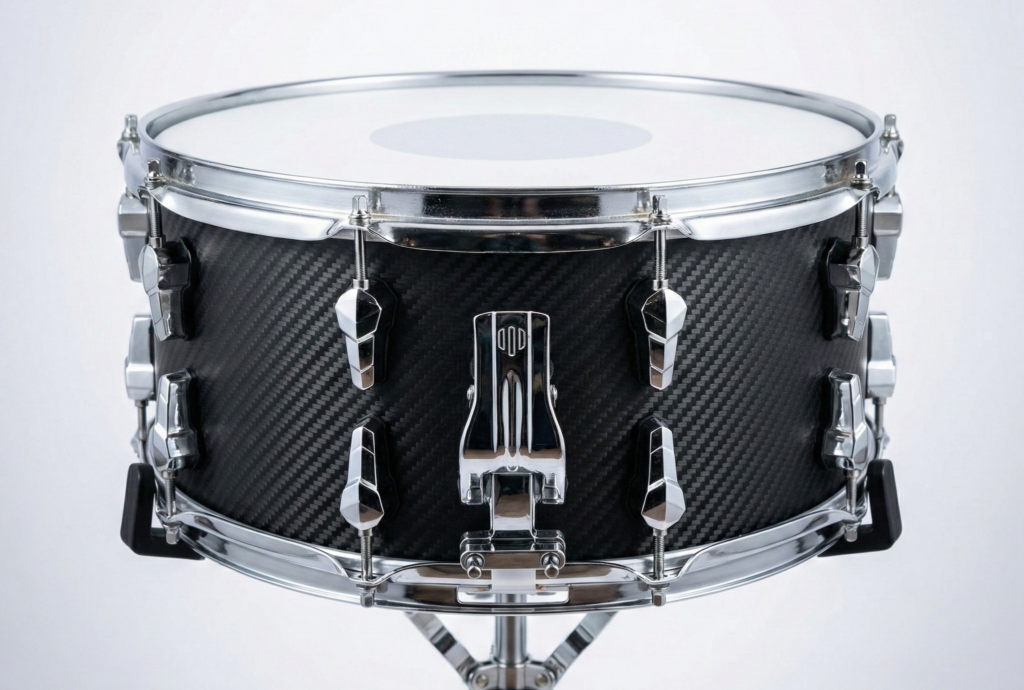
The Carbon Fiber Series stems from a clear and deliberate choice: not to pursue wood. Wood represents tradition, history, and the culture of violin making. But that's not where we play.
AluVibe was born from a different background: engineering, advanced prototyping, and structural materials. Its DNA is deeply rooted in the high-end automotive sector, where carbon fiber isn't just a cosmetic touch but a functional tool for achieving superior performance.
The question driving this program is simple: what happens when you apply automotive engineering principles to the construction of a drum shell for percussion instruments?
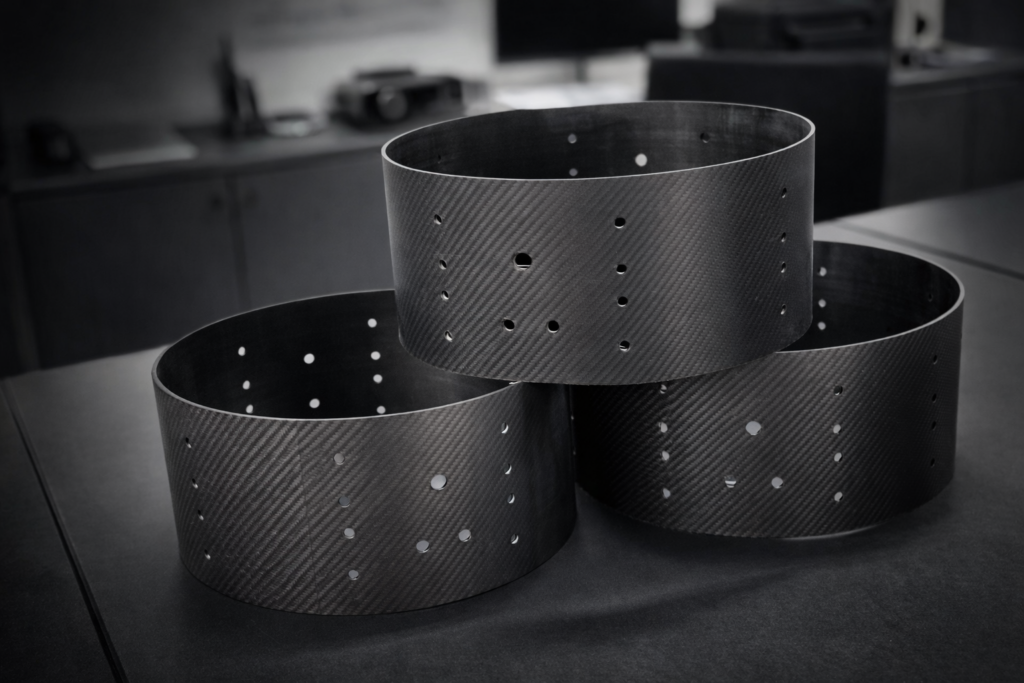
Carbon fiber is an anisotropic material that is extremely rigid and lightweight, with highly predictable mechanical behavior.
In the automotive world, it is used for frames, monocoques, and structural components by premium brands for three key reasons: very high rigidity, reduced weight, long-term stability.
Entering the world of percussion instruments, these principles open up different soundscapes compared to traditional materials: more controlled parasitic vibrations, a more focused response, and greater coherence.
The shells are made using roll-wrapping on a mandrel, a controlled lamination process that ensures a consistent thickness, concentricity, and repeatable dimensions.
The process also allows for working with non-standard diameters and geometries, adapting the layering to achieve the desired acoustic performance.
The holes for the hardware components are cut using a 5-axis laser.
The fiber's torsional stiffness allows for extremely solid shafts that can withstand mechanical stress, high skin tensions, and extreme stringing.
Carbon fiber offers exceptional dimensional stability: no moisture absorption, no significant expansion, and constant geometry over time.
The result is a structure that functions as a single unit, without unwanted micro-deformations that dissipate energy or introduce instability into the sound.
AluVibe has established a reference thickness of 3 mm, which strikes a balance between rigidity, vibration capacity, and mechanical workability.
Each shell is finished internally by AluVibe, with dedicated processes for the bearing edge, flatness, and bonding with hardware and skins.
The exposed fiber is a defining feature: no unnecessary coating, no “plastic” effect.
Explored finishes: natural carbon, light polishing, and a matte clear coating—choices that don't alter the material's behavior and keep the structure visible.
AluVibe • Designed, built, and assembled in Turin, Italy
Follow us
© 2026 AluVibe di Omar Griffa • P.IVA 13468120012 • Sede operativa Via Corradino 20, Moncalieri (Torino) – Italia. All rights reserved. • Privacy & Cookie